New Funding Options for Existing Condominium Buildings
For many condominium associations, identifying necessary building repairs is only the first challenge. The larger question is how to pay for the work without waiting years to accumulate reserves or placing the entire immediate burden on unit owners.
Lasher Construction now offers access to Jersey Shore condominium repair and restoration financing up to $5 million for qualified projects, giving condominium boards and property managers another way to move essential repairs and capital improvements forward. This financing is intended for repairs, restoration, and capital improvements at existing condominium properties—not new condominium development.
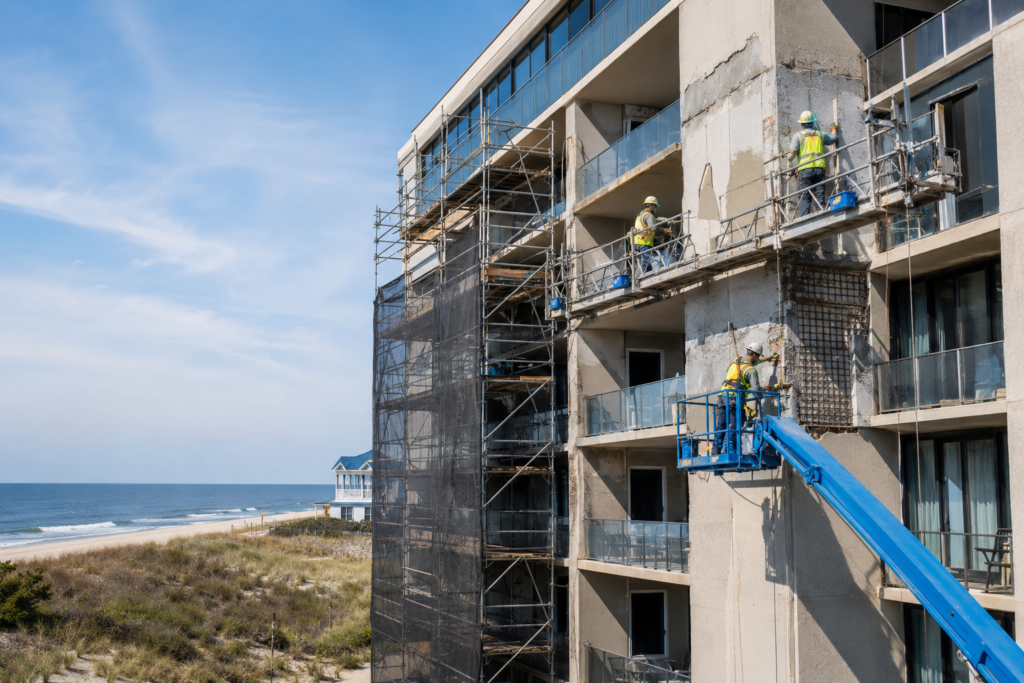
Financing may be available for structural restoration, concrete and balcony repairs, structural steel replacement, façade and masonry restoration, roofing and waterproofing, building-envelope rehabilitation, parking structures, foundations, and other common-element repair projects.
The goal is straightforward: help qualified associations turn an identified building need into a properly planned, funded, and completed project.
Why Jersey Shore Condominium Financing Matters Now
Condominium buildings along the New Jersey coast face demanding conditions. Salt air accelerates corrosion. Wind-driven rain enters failed joints and exterior assemblies. Repeated wetting, drying, freezing, and thawing can damage concrete and masonry. Aging waterproofing systems may allow hidden deterioration to advance long before the full extent of the problem becomes visible.
At the same time, New Jersey associations are operating under increased structural-inspection and reserve-planning requirements. The state’s Structural Integrity Law, P.L. 2023, c. 214 established inspection requirements for covered condominium and cooperative buildings. Separate provisions in the law require applicable associations to address the adequacy of capital reserves through professional reserve studies and 30-year funding plans. The law defines covered buildings to include certain condominium and cooperative buildings with concrete, masonry, steel, heavy-timber, hybrid, or podium-deck structural systems, subject to statutory exclusions.
For covered buildings, the evaluation of the primary load-bearing system includes connected or attached balconies. A structural inspection report must identify required maintenance or repairs and establish the timing of a future inspection. Separate reserve-study provisions require applicable associations to evaluate anticipated common-element repair and replacement costs, including costs related to structural integrity and corrective maintenance.
New Jersey’s current reserve-study statutes, including the 2025 amendments, also recognize that association funding decisions may involve a future special assessment or loan under certain reserve-funding circumstances. Financing does not replace an association’s inspection, reserve-study, maintenance, or legal obligations. It can, however, provide a practical source of capital when required work cannot responsibly wait for reserves to accumulate.
What Types of Condominium Projects May Be Financed?
Qualified associations may seek financing for a wide range of Jersey Shore condominium construction and restoration projects, including:
- Structural concrete repair and replacement
- Balcony restoration, reconstruction, and waterproofing
- Concrete spall repair and reinforcing-steel treatment
- Structural steel beam, column, lintel, and connection repairs
- Masonry stabilization, repointing, and façade restoration
- Stucco, EIFS, sealant, and exterior-envelope rehabilitation
- Parking garage and podium-deck repairs
- Foundation stabilization, piles, and structural support work
- Commercial roofing and condominium roof replacement
- TPO roofing, roof coatings, and low-slope roofing systems
- Waterproofing membranes and deck-coating systems
- Window, door, flashing, and penetration repairs associated with water intrusion
- Emergency shoring and engineer-directed corrective maintenance
- Code-related common-element repairs and major capital improvements
Every building and financing request is different. Project eligibility, available amount, loan structure, documentation, security, rates, and repayment terms depend on underwriting and the association’s circumstances.
From Structural Adequacy Findings to a Funded Repair Program
A structural inspection, reserve study, property-condition assessment, or engineering report may reveal work that should be completed sooner than the association’s existing reserves permit. That gap can leave a board choosing among delay, a substantial special assessment, or a reduced scope that does not fully address the underlying condition.
Condominium project financing can give a qualified association another option. Depending on the program and approval, financing may allow the association to:
- Begin priority work before collecting the full project cost from owners
- Spread repayment over time instead of requiring one large payment
- Coordinate a complete repair program rather than repeatedly mobilizing for small phases
- Address active deterioration before it becomes more extensive and expensive
- Preserve an appropriate portion of existing reserves for other scheduled capital needs
- Align construction timing with engineering recommendations, seasonal access, and occupancy needs
Borrowing still creates a financial obligation for the association and its members. The board should review all options with association counsel, its accountant or financial adviser, the reserve professional, the project engineer, and the financing source before making a decision.
Financing, Reserves and Special Assessments: Understanding the Options
Most associations fund major projects through one method or a combination of methods.
| Funding approach | Practical consideration |
| Existing reserves | Avoids borrowing but may reduce funds available for other scheduled components. Use should be evaluated against the current reserve study and governing requirements. |
| Special assessment | Raises project funds directly from unit owners but may create a substantial short-term burden or collection delay. |
| Condominium association financing | May allow work to begin sooner and spread the association’s repayment over time, but approval, interest, fees, and repayment obligations apply. |
| Blended funding plan | Combines reserves, an assessment, and financing to balance available cash, owner impact, and project timing. |
There is no single structure that is right for every community. A well-developed plan starts with the actual condition of the building, an engineer-supported scope, a realistic construction budget, and a clear understanding of the association’s financial position.
Condo lending in New Jersey is different from an individual unit owner’s mortgage or home-improvement loan. For association-level repair financing, the financing source commonly evaluates the condominium association, its governing authority, financial condition, assessment collections, and the proposed restoration project. Exact underwriting and security requirements vary by program.
Signs a Jersey Shore Condominium May Need Structural or Building-Envelope Repairs
Not every crack or leak indicates a serious structural problem. However, recurring or worsening conditions should be evaluated by an appropriately licensed professional. Common warning signs at coastal condominium properties include:
- Cracked, delaminated, or spalling concrete
- Rust staining or exposed reinforcing steel
- Deteriorated balcony edges, slabs, columns, or rail connections
- Corroded structural steel or displaced connections
- Cracked, bulging, or displaced masonry
- Failing lintels, shelf angles, parapets, or façade components
- Persistent roof, wall, window, or balcony leaks
- Failed sealants and open building-envelope joints
- Sagging, movement, settlement, or unusual deflection
- Water-damaged framing, sheathing, or structural components
- Repeated temporary repairs that do not resolve the source of intrusion
The earlier a board understands the cause and extent of deterioration, the more effectively it can plan the scope, budget, financing, resident communication, and construction sequence.
How Condominium Repair and Restoration Financing Works
- Initial Project Review
Lasher Construction meets with the condominium board, property manager, engineer, or association representative to understand the building condition, existing reports, desired scope, schedule, and estimated construction cost.
- Scope and Budget Development
The association and its professional team establish the proposed work. Depending on the project, this may include engineering documents, destructive investigation, testing, repair details, bidding, phasing, access planning, and allowances for concealed conditions.
- Financing Review
The financing source evaluates the association and proposed project. Information commonly requested may include association financial statements, budgets, reserve balances, unit count, assessment history, owner delinquencies, governing documents, board authority, reserve studies, engineering reports, project specifications, and the proposed construction contract.
- Association Evaluation and Approval
The board reviews the proposed financing terms with its legal and financial advisers, confirms its authority and approval process, and evaluates the effect on association cash flow and unit owners.
- Construction Planning and Mobilization
Once the contract, financing, permits, engineering, and required approvals are in place, Lasher coordinates procurement, access, resident communication, safety, scheduling, and construction.
- Project Administration Through Completion
Lasher manages the construction process from mobilization through closeout, coordinating with the association, management, design professionals, inspectors, subcontractors, and other stakeholders.
A Jersey Shore Contractor That Understands Condominium Construction
Condominium restoration is different from ordinary construction. The work occurs in an occupied community, often around residents, tenants, guests, vehicles, balconies, entrances, and seasonal rental schedules. Board members must weigh safety, cost, appearance, disruption, legal responsibilities, reserve planning, and owner communication at the same time.
Established in 1990 and based in Linwood, New Jersey, Lasher Construction specializes in structural restoration, roofing, waterproofing, building-envelope repair, and complex construction for condominium communities and waterfront properties. Our team understands the coordination required to execute major work in active multi-unit buildings and the importance of clear documentation, practical phasing, and direct communication.
Associations can engage Lasher for projects involving deteriorated concrete, balconies, structural steel, masonry façades, parking structures, roofs, waterproofing systems, foundations, and other major common elements. We work with association boards, property managers, engineers, architects, reserve professionals, attorneys, and financing sources to help move projects from evaluation through construction.
Serving Condominium Associations Across the Jersey Shore
Lasher Construction serves condominium and waterfront properties throughout Atlantic County, Cape May County, Ocean County, and surrounding New Jersey communities.
Our Jersey Shore service area includes Atlantic City, Brigantine, Ventnor, Margate, Longport, Somers Point, Ocean City, Sea Isle City, Avalon, Stone Harbor, North Wildwood, Wildwood, Wildwood Crest, Cape May, Long Beach Island, Beach Haven, Ship Bottom, Surf City, and nearby coastal communities.
Whether your association is planning a future capital improvement or responding to a structural inspection, reserve study, active leak, façade issue, balcony condition, or engineer-directed repair, Lasher can help evaluate the construction requirements and available path forward.
Discuss Your Jersey Shore Condominium Project
If your association needs to complete structural repairs, balcony restoration, concrete work, façade rehabilitation, roofing, waterproofing, or another major capital project, a lack of immediately available reserves does not have to end the conversation.
Contact Lasher Construction to discuss your building, proposed scope, construction budget, and potential financing options up to $5 million.
Call or text: (856) 375-2372
Location: Linwood, New Jersey
Website: lashercontracting.com