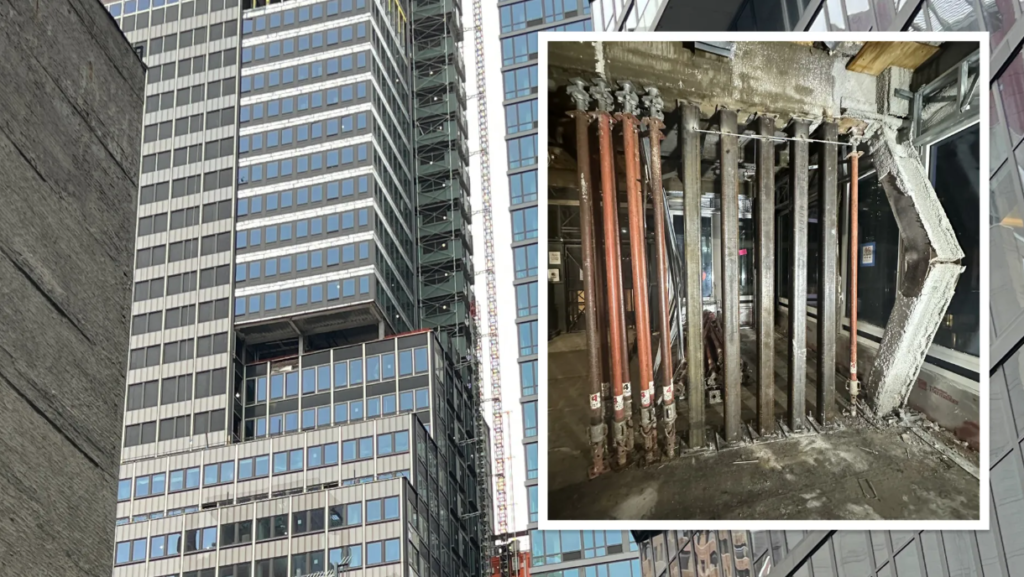
When structural columns buckled inside a Manhattan office tower undergoing conversion into residential apartments, the immediate focus was on protecting the public. Workers were evacuated, surrounding streets were closed, and emergency shoring was installed to stabilize the building. Within a day, much of the reporting shifted to the fact that the structure had been stabilized, giving many people the impression that the emergency had largely passed.
From a structural restoration perspective, that is only the beginning of the project.
Emergency shoring is not a repair. It is a temporary structural system designed to support portions of a building that can no longer safely carry their intended loads. Its purpose is to prevent additional movement while engineers investigate the failure, evaluate the extent of the damage, and design a permanent repair. Until that process has been completed, the building remains dependent on temporary supports rather than its permanent structural system.
One of the most overlooked aspects of structural failures is that the visibly damaged member is rarely the only concern. Buildings function as complete structural systems, and when one column loses capacity, the loads it was carrying must be redistributed elsewhere. That redistribution may place additional demands on beams, connections, floor framing, or adjacent columns that appear undamaged during an initial visual inspection. Determining how those loads moved through the structure is often one of the most important parts of the engineering investigation.
This is also why restoration work on existing buildings is significantly different from new construction. Every building carries decades of history that cannot always be seen on the original drawings. Previous renovations, undocumented alterations, corrosion, water intrusion, settlement, and aging materials all influence how the structure performs. The conditions uncovered during demolition frequently become just as important as the conditions shown on the plans.
Once the investigation is complete, engineers can begin designing a permanent repair. Depending on the findings, that may involve reinforcing existing steel members, replacing damaged framing, restoring concrete, strengthening connections, or modifying the structural system to safely redistribute loads. Throughout that process, the emergency shoring remains in place because it continues performing work that the permanent structure has not yet resumed.
The removal of temporary shoring is one of the final phases of a structural restoration project and is carefully engineered. The supports are not removed simply because repairs appear complete. They remain until the engineer of record has verified that the restored structure can safely carry its intended loads. Only then can the temporary supports be removed in a controlled sequence while the building is monitored for movement or unexpected behavior.
The Manhattan project will ultimately be remembered for the engineering investigation that follows, not simply for the emergency response. Whether the cause is determined to be construction sequencing, unforeseen existing conditions, loading, or another factor, the most valuable lesson extends beyond this single project. Temporary stabilization protects a building during an emergency, but permanent structural restoration is what returns it to service. Confusing those two phases oversimplifies one of the most complex processes in the construction industry.